Showing posts with label Patient Safety. Show all posts

Sunday, 22 July 2012

NABH Chapter 5 – Hospital Infection Control (HIC): Some references for making the Infection Control Manual

As part of NABH chapter HIC standard 2, there is a requirement for Infection Control Manual and the standard gives detailed guidelines on the components of the manual through its various objective elements. It also suggests CDC’s guidelines as good reference material for various infection control practices and areas.
Centre for Disease Control and Prevention (CDC) has specific guidelines for each kind of high-risk area to prevent Healthcare-associated Infections, or HAIs. Get CDC’s definition for HAIs here: http://www.cdc.gov/hai/

Get all the information about CDC guidelines for Infection control by visiting the following page: http://bit.ly/OaRTqZ 

More specifically, CSSD related guidelines, as suggested in NABH HIC 2F, are available in the CDC guidelines for Disinfection and Sterilization in Healthcare Facilities, 2008 at the following link: http://bit.ly/OQD64S

If you have time, you can also watch this 2 minute video in which Dr. Denise Cardo, Director of the Division of Healthcare Quality Promotion, CDC, speaks about HAIs as a threat to Patient Safety and how we can respond to this challenge.


Saturday, 21 July 2012

WHO ‘Safe Surgery Saves Lives’ Checklist: NABH COP 14

While dealing with care of patients who are undergoing surgical procedures, NABH recommends hospitals to refer to WHO ‘Safe Surgery Saves Lives’ Initiative. In this post, I bring to you a complete detail around the initiative and the checklist. This is also an important example that Dr. Atul Gawande quotes in his book – ‘The Checklist Manifesto: How to get things right’ and is one of my favourite books.

All the references are from the WHO’s website.

You can read an overview of the checklist on this page: http://bit.ly/OgsVIH

You can have a look at this 19 pointer checklist on the 20th page of the pdf available on this link: http://bit.ly/NStgEM

I am sure you will have a lot of questions on what this checklist is all about and how to use it and is it applicable in your hospital. Don’t worry, WHO provides answers here: http://bit.ly/MtqbcY

And if you want to get a feel of how to do this checklist, watch the video below:


I’ve shown this video to 2 different audiences and both agreed that this checklist is short and crisp and can take care of a lot of elementary goof-ups that happen in their OTs and enhance patient safety. If you noticed, it doesn’t take more than 2 minutes each time you do the checklist. I think that’s time worth spent in protecting our patients.

Update on 30/08/2013
Based on a viewer comment, I felt there have to be other illustrations and videos for Safe Surgery Checklist which helps in better understanding of its implementation.

Below is a video from a hospital in Australia where a patient is undergoing Hip Replacement procedure. This one has the Pre-Incision (Time-Out) and Post-Procedure (Sign-Out) shoot only, but in a better detail.


This is another video from St. John of God Hospital in Australia. This one has two-part, the first one about how to do the Safe Surgery Checklist, and the second one about how not to do the checklist.


Patient Safety – The Johns Hopkins’ Way

One aspect of patient safety is to involve the patients and their family members in the care delivery process. When they are involved in their care delivery, they tend to recover faster and remain safer. This is what Dr. Peter Pronovost of Johns Hopkins Hospital shares with us through a Patient Safety video created by the hospital. The video below fantastically points out ways and means by which patients can be engaged in their care delivery process and how this can help in better clinical outcomes. As you watch this video, you will come across some common, yet powerful, ways of patient safety.


Dr. Peter discusses 4 ways by which the patients can get involved. These are:
  • Ask Questions: The patients should ask their care givers questions about their health, treatment plans, day-to-day treatment activities and anything else they need to know.
  • Provide Accurate Information: By providing accurate information about their medical history and any kind of medications they have been taking, patients help the care givers ensure that the current medications patient is taking do not interfere with the medicines they are going to prescribe.
  • Speak Up: The patients are encouraged to speak up and inform the care givers if they think they are being given the wrong medications or something about their treatment is wrong. They can even ask care givers about whether they are following hand hygiene.
  • Follow the Plan: The patients are advised to follow the treatment plan prepared by their care givers and take their help whenever required.
I believe this has a lot of relevance for Patient education in our healthcare facilities. Even from NABH standards perspective, these practices can be usefully implemented for compliance to chapter 4 – Patient Rights and Education. If you find this useful, please share your thoughts.

Thinking about NABH implementation in your hospital? First observe the aviation industry.

During a recent NABH training session at one of our client hospitals, we got into an interesting discussion which generally happens in most hospitals that are planning to go for the accreditation. The point of discussion was: While one can get all the hospital staff to comply with the various NABH standards and requirements, it is nearly impossible to get all the doctors to follow the standards and protocols. They have such high egos and they do not listen to anyone. If you try and change their ways, either they blast you or they threaten to leave your hospital. It’s a waste to time to talk to them about quality and accreditation.

I have heard this discussion many times. I have been on the other side, been an administrator and heard such tales from one and all. A closer look at ‘Remarks’ in objective elements of many NABH standards will reflect that those elements require participation from doctors too. So whatever be the problem your hospital faces in convincing doctors, NABH wants you to get them to comply. So how should you tackle this issue?

To this group of audience, I gave the example of aviation industry. Most people in the audience had travelled by air and agreed with me that each one of them had to go through the mandatory physical check, baggage check, ticket check and many such little checks before finally boarding the flight. Even when someone was late for the flight and his/her name was being called, nowhere that individual was allowed to skip any of the security checks. And if you forget to carry your tickets or ID at the airport entrance, you won’t be allowed to enter the airport, forget entering the flight.


Even CEOs, bureaucrats and politicians, whatever may be their status, need to go through these checks. The pilots and the flight crew also have to go through checks and all these procedures are followed to ensure safety of everyone during the flight.


So my point is that if aviation industry can follow strict protocols for every human being involved, why can or should the hospitals not follow strict patient and staff safety protocols? The safety risks are much higher in healthcare because of the infection risks which can affect patients, visitors and the healthcare professionals alike.


I think we need to involve doctors in a dialogue without any pre-conceived notions about their willingness to participate in a quality program. If the benefits of engaging in a quality program are clearly understood, everyone, including doctors, would agree to go through the rigorous process of the accreditation and compliance to the standards thereafter. More than anything, conviction, patience and ability to connect with a varied set of healthcare professionals should be the hallmark of a Quality professional. Right outcomes are the by-product of the right approach.

Thursday, 31 May 2012

The language of signs: How sufficient and effective sign-boards take you one step closer to NABH accreditation

Hospitals are a public place and attract a diversity of mankind who come to the facility to get healed. As hospital administrators, we spend enormous time building a credible clinical team and a functional hospital structure. But one area which constantly misses the attention of administrators is the sign-boards inside the hospital.

Since we work in a hospital, we are used to its many departments and we are aware of their locations. But can we expect a first-time patient to know what all facilities our hospitals offer and where are they all located? Also, all kinds of patients who speak various languages visit the hospitals and there is a decent chance that some patients might not know English, Hindi and even the local language of the city/state in which the hospital is set up (for example, medical tourists from other countries or Indian patients who travel from one part of the nation to another part for treatment). So language can be a big barrier in communication as well apart from lack of sign-boards.

NABH team felt that most hospitals lack this ability to provide sound directions to their patients. This probably is the reason why there is a lot of focus on signages in NABH quality standards and it forms as one of the assessment criteria.

Hospitals and healthcare facility, new or old, can begin by thinking through the various facilities they offer and developing sign boards on them. Care should be taken to prefer signs over text-based signages or a hybrid can be used.

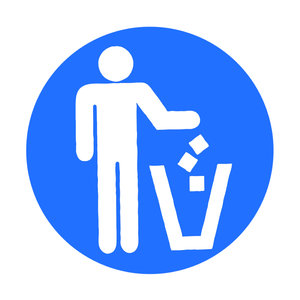
For the sake of creating cleaner environment, you could place dust-bins at various places and could use following sign –
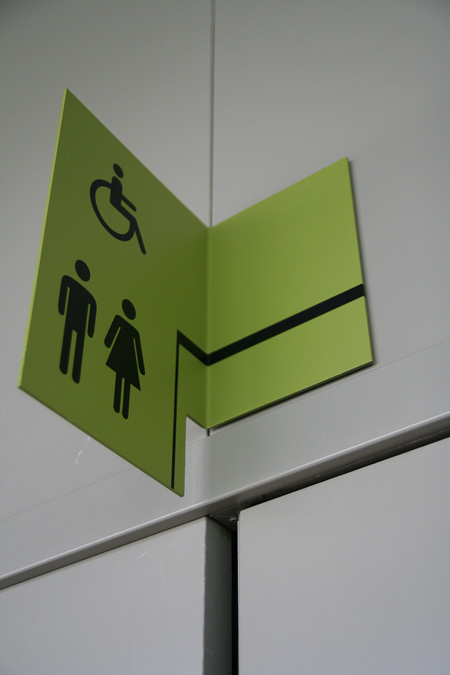
Toilets are another facility that most visitors would like to use. Rather than placing a sticker on the toilet door/wall, it would be better to use signages at an angle to the wall, like the following example –


Also notice the use of the image for physically-challenged visitors. A common requirement of visitors is to locate lift or staircases to move to various sections of the hospital building. Sign-boards could come handy here too –


But a sign board with text, sign and direction would be much appreciated by the visitors.
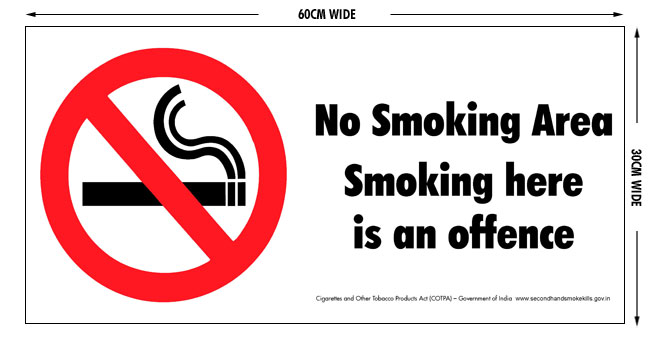
Since hospital is a public place and certain visitors who intentionally or unintentionally smoke inside your premises can create disturbance for other people, having signs to discourage smoking can be a good idea –


Letting patients know the services offered in a particular part of the building will also avoid patients to unnecessarily waste their waiting time in areas where they are not supposed to be –


NABH puts a lot of focus on patient safety and this requires administrators to create fire-safe buildings and provide enough information signs to visitors in the event of a fire disaster. One area to help visitors/staff is to extinguish fire through prompt action is to provide fire extinguishers at various places and put requisite signages –

Here again, a sign-board at an angle to the wall should be a preferred option –


In many hospitals, basic signs for escape/exit routes are not provided which can be a major risk to patients’ safety. Simple signs like below can enhance the safety of your patients/visitors/staff –
Informing visitors and staff to stay away from lifts during a fire emergency can also save lives –

More than anything, it requires your common sense to design a patient-friendly hospital building and a visitor-friendly signage system.