The updated guidelines on OT design are available on NABH website and readers can refer to the following link to apprise themselves of the requirements.
Sunday, 22 July 2012
NABH guidelines on OT air-conditioning: NABH HIC 2-J

NABH Chapter 5 – Hospital Infection Control (HIC): Some references for making the Infection Control Manual
As part of NABH chapter HIC
standard 2, there is a requirement for Infection Control Manual and the
standard gives detailed guidelines on the components of the manual through its
various objective elements. It also suggests CDC’s guidelines as good reference
material for various infection control practices and areas.
Centre for Disease Control and
Prevention (CDC) has specific guidelines for each kind of high-risk area to
prevent Healthcare-associated Infections, or HAIs. Get CDC’s definition for
HAIs here: http://www.cdc.gov/hai/
Get all the information about CDC
guidelines for Infection control by visiting the following page: http://bit.ly/OaRTqZ
More specifically, CSSD related
guidelines, as suggested in NABH HIC 2F, are available in the CDC guidelines
for Disinfection and Sterilization in Healthcare Facilities, 2008 at the
following link: http://bit.ly/OQD64S
If you have time, you can also
watch this 2 minute video in which Dr. Denise Cardo, Director of the Division
of Healthcare Quality Promotion, CDC, speaks about HAIs as a threat to Patient
Safety and how we can respond to this challenge.
Saturday, 21 July 2012
WHO ‘Safe Surgery Saves Lives’ Checklist: NABH COP 14
While dealing with care of
patients who are undergoing surgical procedures, NABH recommends hospitals to
refer to WHO ‘Safe Surgery Saves Lives’ Initiative. In this post, I bring to
you a complete detail around the initiative and the checklist. This is also an
important example that Dr. Atul Gawande quotes in his book – ‘The Checklist
Manifesto: How to get things right’ and is one of my favourite books.
All the references are from the
WHO’s website.
You can read an overview of the
checklist on this page: http://bit.ly/OgsVIH
You can have a look at this 19
pointer checklist on the 20th page of the pdf available on this
link: http://bit.ly/NStgEM
I am sure you will have a lot of
questions on what this checklist is all about and how to use it and is it applicable
in your hospital. Don’t worry, WHO provides answers here: http://bit.ly/MtqbcY
And if you want to get a feel of
how to do this checklist, watch the video below:
I’ve shown this video to 2
different audiences and both agreed that this checklist is short and crisp and
can take care of a lot of elementary goof-ups that happen in their OTs and
enhance patient safety. If you noticed, it doesn’t take more than 2 minutes
each time you do the checklist. I think that’s time worth spent in protecting
our patients.
Update on 30/08/2013
Based on a viewer comment, I felt there have to be other illustrations and videos for Safe Surgery Checklist which helps in better understanding of its implementation.
Below is a video from a hospital in Australia where a patient is undergoing Hip Replacement procedure. This one has the Pre-Incision (Time-Out) and Post-Procedure (Sign-Out) shoot only, but in a better detail.
This is another video from St. John of God Hospital in Australia. This one has two-part, the first one about how to do the Safe Surgery Checklist, and the second one about how not to do the checklist.
NABH COP-5: The new standard on nursing care
NABH 3rd edition has
brought with it a host of new requirements and probably gives a hint on what to
expect in the years ahead for quality accreditation and Indian healthcare. There’s
this new standard COP-5 on nursing care and I found one objective element, i.e.
COP 5G, of particular interest. The statement of the objective elements is “Nurses
are empowered to take nursing-related decisions to ensure timely care of
patients”. The interpretation says “Self-explanatory”. And I always thought
that nurses are required to only follow orders!!

This standard requires nurses to
prepare their own ‘Nursing care plan’ for each patient. I wonder whether we
have adequate teaching standards in our nursing schools and colleges where they
can teach clinical discretion to the new generation of nurses because most
nursing superintendents I meet always crib about the quality of new nursing
workforce.
I guess this ‘nursing care plan’
requirement will increase the expectations and work load on the already
overloaded nurses in our hospitals. And can anyone please explain to me, what
is the scope of ‘nursing-related decisions’ in COP 5G, and if these decisions
are anyways related to nursing, why do we need to empower them?
My personal knowledge is limited
in this aspect of patient care and I have no idea about the nursing protocols.
But whatever I have observed, I think nurses are supposed to follow the orders
of the doctors as well as manage the care plan for the patient developed by the
doctor (in his absence). When we speak of empowering nurses in nursing-related
decision making, how can I make sense of it? Knowledgeable people on this
topic, please guide me with your comments.
Patient Safety – The Johns Hopkins’ Way
One aspect of patient safety is
to involve the patients and their family members in the care delivery process. When
they are involved in their care delivery, they tend to recover faster and
remain safer. This is what Dr. Peter Pronovost of Johns Hopkins Hospital shares
with us through a Patient Safety video created by the hospital. The video below
fantastically points out ways and means by which patients can be engaged in
their care delivery process and how this can help in better clinical outcomes.
As you watch this video, you will come across some common, yet powerful, ways
of patient safety.
Dr. Peter discusses 4 ways by
which the patients can get involved. These are:
- Ask Questions: The patients should ask their care givers questions about their health, treatment plans, day-to-day treatment activities and anything else they need to know.
- Provide Accurate Information: By providing accurate information about their medical history and any kind of medications they have been taking, patients help the care givers ensure that the current medications patient is taking do not interfere with the medicines they are going to prescribe.
- Speak Up: The patients are encouraged to speak up and inform the care givers if they think they are being given the wrong medications or something about their treatment is wrong. They can even ask care givers about whether they are following hand hygiene.
- Follow the Plan: The patients are advised to follow the treatment plan prepared by their care givers and take their help whenever required.
WHO 5 Moments: Some ideas for NABH Chapter 5 - Hospital Infection Control
While preparing for my training sessions
on chapter 5 – Hospital Infection Control, I came across an interesting video
on Youtube. The video has been prepared by DebMed Healthcare and covers the WHO
‘5 Moments’. The video focuses on Hand Hygiene and presents the idea in an
interesting Rap where you will 5 boys and girls, apparently nurses, dance and
enact various situations (5 Moments) where hand hygiene can prevent the spread
of infection. Have a look at this short entertaining video!
Notice at 2:15 it is shown that
the doctor doesn’t comply with the hand hygiene and the nurse stops him and
sends him back to use the sanitizer.
While it may come as a cultural
shock to Indian hospitals, the fact is that it is part of NABH compliance too. The latest NABH 3rd edition talks about Infection Prevention and Control. To prevent the
infections from spreading, strict hand hygiene is a must. And I think it is a
sensible organizational culture to have where each employee can demand
compliance from every other employee.
Thinking about NABH implementation in your hospital? First observe the aviation industry.
During a recent NABH training
session at one of our client hospitals, we got into an interesting discussion
which generally happens in most hospitals that are planning to go for the
accreditation. The point of discussion was: While one can get all the hospital
staff to comply with the various NABH standards and requirements, it is nearly
impossible to get all the doctors to follow the standards and protocols. They have
such high egos and they do not listen to anyone. If you try and change their
ways, either they blast you or they threaten to leave your hospital. It’s a
waste to time to talk to them about quality and accreditation.

Even CEOs, bureaucrats and politicians, whatever may be their status, need to go through these checks. The pilots and the flight crew also have to go through checks and all these procedures are followed to ensure safety of everyone during the flight.


I have heard this discussion many
times. I have been on the other side, been an administrator and heard such
tales from one and all. A closer look at ‘Remarks’ in objective elements of
many NABH standards will reflect that those elements require participation from
doctors too. So whatever be the problem your hospital faces in convincing
doctors, NABH wants you to get them to comply. So how should you tackle this
issue?
To this group of audience, I gave
the example of aviation industry. Most people in the audience had travelled by
air and agreed with me that each one of them had to go through the mandatory
physical check, baggage check, ticket check and many such little checks before
finally boarding the flight. Even when someone was late for the flight and
his/her name was being called, nowhere that individual was allowed to skip any
of the security checks. And if you forget to carry your tickets or ID at the
airport entrance, you won’t be allowed to enter the airport, forget entering
the flight.

Even CEOs, bureaucrats and politicians, whatever may be their status, need to go through these checks. The pilots and the flight crew also have to go through checks and all these procedures are followed to ensure safety of everyone during the flight.

So my point is that if aviation
industry can follow strict protocols for every human being involved, why can or
should the hospitals not follow strict patient and staff safety protocols? The safety
risks are much higher in healthcare because of the infection risks which can
affect patients, visitors and the healthcare professionals alike.

I think we need to involve
doctors in a dialogue without any pre-conceived notions about their willingness to
participate in a quality program. If the benefits of engaging in a quality program
are clearly understood, everyone, including doctors, would agree to go through
the rigorous process of the accreditation and compliance to the standards
thereafter. More than anything, conviction, patience and ability to connect with
a varied set of healthcare professionals should be the hallmark of a Quality
professional. Right outcomes are the by-product of the right approach.
Friday, 13 July 2012
Why Quality professionals do not become CEOs?
Very interesting question posted by Mr. Hoskote, Senior Director, Quality and Performance Excellence at Max India Group. I had the opportunity to explore the ASQ's online resources today and I'm amazed at the work the organization is doing in this field and that such a large network exists today.
I watched Mr. Hoskote's talk on ASQ's Facebook page: https://www.facebook.com/ASQ and those who do not access facebook, can watch this video on another interesting website from ASQ - Quality for Life... http://www4.asq.org/qualityforlife

Now the question is very pertinent to the discipline. Frankly speaking, he's very right that quality professionals miss the woods for the trees. The entire focus on process and its related aspects take them away from the requirements of business. For sure, all functions of the enterprise should align themselves to the basis premise of the enterprise, i.e. to make money for the share/stake holders. Nobody says that quality doesn't result into more money for the enterprise, rather, it generates more value. But the quality guys should be able to themselves see this impact and should be able to convey the same to the decision-makers in the organization.
In one of our client hospitals where we are assisting the management to implement NABH standards, there is a very clear understanding the management has that their hospital has to prepare itself for the needs of the patients of tomorrow and for that, it has to benchmark itself against a quality system like NABH and continuously strive to build their brand based on solid performance. The stronger brand would result into better business and higher margins for the hospital, apart from the goodwill it will create in the community.
I think quality professionals should take this message from Mr. Hoskote seriously and attempt to align their roles with the needs of the business of their respective healthcare organizations.
Quality in Healthcare - ASQ India
Recently came across this presentation by ASQ India (American Society for Quality) on Quality in Healthcare - Indian Scenario.
The presentation gives a peek into the Indian healthcare context and various quality paradigms like ISO, NABH, JCI, Lean, Six Sigma, Malcolm Balridge etc. which can be applied to healthcare.
Thursday, 5 July 2012
PeopleHosp Bangalore: Voices from the Conference
The conference on Human Resource
Management in Healthcare, named PeopleHosp, was organized by AMEN on July 4th
at Ashraya International Hotel in Bangalore. The conference attracted HR
professionals from hospitals from Bangalore and outside.


He put forth questions on how to deal with a large employee-base who is required to deliver personalized care to the patients, how to design systems that ensure customer centricity at each employee level and how to ensure sensitivity among the staff on medico-legal aspects of their profession. In the end, he emphasized the role of HR in driving critical circuits in the organization, in being the advisor to the business head while managing the core responsibilities of the function, managing risk, creating change and making a difference to the enterprise. He signed off by proposing the ‘competency way of thinking’ for managing HR in healthcare.


The conference opened with an
interesting talk by Mr. Siddharth N, General Manager & Head HR for
Cloudnine Hospitals, Bangalore. His topic covered a futuristic view on HR
competencies required in healthcare. The presentation, made enjoyable with a
healthy dose of cartoons, discussed some key challenges facing the industry,
like training, retention, sourcing, lack of discipline among the new breed of
employees, lack of English speaking skills among the prospective employees,
professionalism, skill-levels, employability and ramping-up of operations.

He put forth questions on how to deal with a large employee-base who is required to deliver personalized care to the patients, how to design systems that ensure customer centricity at each employee level and how to ensure sensitivity among the staff on medico-legal aspects of their profession. In the end, he emphasized the role of HR in driving critical circuits in the organization, in being the advisor to the business head while managing the core responsibilities of the function, managing risk, creating change and making a difference to the enterprise. He signed off by proposing the ‘competency way of thinking’ for managing HR in healthcare.
Ms. Nagarathna A, Asst. Prof. of
Law at National Law School – Bangalore, shared her insights on ‘Statutory and
Legal issues related to HRM in hospitals. Dr. Navin Chugh, who heads Quality at
Global Group of Hospitals – Bangalore, discussed the requirements of NABH
quality standards applicable to HRM. He took up the discussion based on the
latest 3rd edition of NABH standards for hospital and provided
suggestions to audience on implementing the standards and facing the audit. When
asked whether doctors practicing alternative medicine (AYUSH) can work in an
allopathic hospital through privileging, he cited MCI regulations and said that
this practice is illegal and therefore will attractive non-conformance in an
NABH Audit. He also shared the practice of daily quality rounds as a means to
monitor process compliance in his hospital.
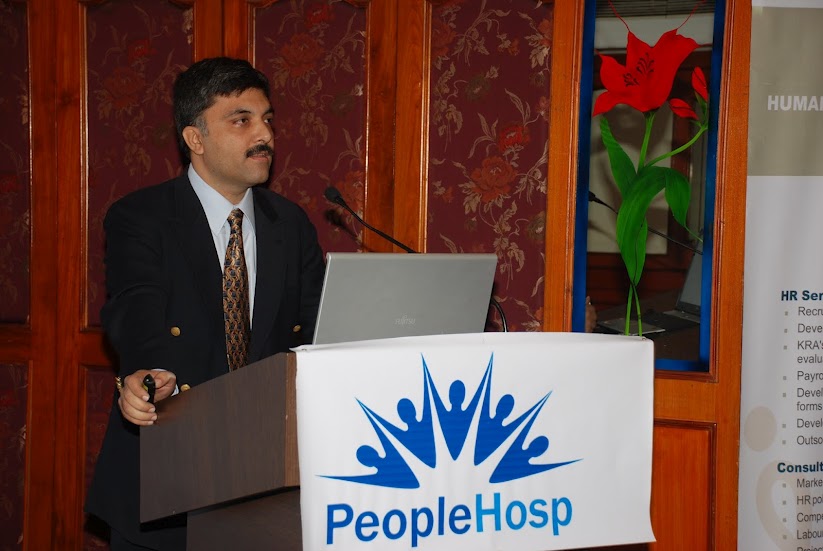
Ms. Reshma Lobo, Principal –
Padmashree College of Hospital Administration Bangalore, gave a talk on
‘Manpower Requirement & Planning for hospitals’. The topic on training of
hospital staff was taken up by Mr. Schreyas Nair, GM – Training and Development,
at Fortis Hospital Bangalore. She explained the approach followed at Fortis
hospital in ensuring that the staff is appropriately trained to work in the
hospital. Her talk began with a discussion on finding out how the training fits
into the agenda of the organization. This, she said, is achieved through an
identity statement for the training department, which in their case covers
aspects like anticipates requirements of the business, be a catalyst of change,
contribute to performance excellence, have people focus and connect, raise the
bar of excellence and enable the organization to fulfill its vision.

She explained that the training
department plans its activities through a 4 step process, which involves
training needs investigation, needs analysis, creation of training modules and
creation of training calendar. One interesting insight she shared about
training at Fortis hospital was the Nurses Leadership program. The program is
undertaken for nurses who show commitment at their work and consistently excel
among their team members. The nurses who undergo this program are selected to
lead floor teams or even head smaller hospitals’ nursing teams. For their
performance management, the balanced scorecard is used which even includes
financial metrics. The metrics focuses on cost reduction through a reduced
Average Length of Stay (ALOS). She highlighted the importance of nurses in
implementing strict infection control processes, thereby reducing the overall
risk to the patients and ensuring a lower ALOS.
Mr. Kiran Gautham, Dy. Director
at Alliance University Bangalore spoke about strategies for effective
selection, recruitment and employee retention. This was followed by a talk by
Mr. Marian Jayson on ‘Performance Appraisals – Tools and Techniques’. His talk
focused on managing performance in the organization and linking the same
through a robust appraisal system where the superior performance is rewarded
and a below-expectation performance attracts strong feedback and strict action.
He also shared insights on ways and means for deciding KRAs (Key Result Areas)
and KPIs (Key Performance Indicators) of various staff levels.

The conference ended with Mr.
Ganesh Selvaraj, VP – HR at Manipal Health Enterprises, sharing his views on
‘Motivating today’s hospital staff’. His presentation was centered on techniques
used at Manipal for motivating its employees. The methods which were employed
by the company included staff-management interaction, employee engagement
exercise, appreciating contribution by senior-most employees of the company at
important events etc.

The conference successfully
touched upon the various aspects of Healthcare HRM with the views of various
industry leaders. The audiences were thoroughly engaged by the speakers and the
question-answer sessions saw good participation from them.
The success of PeopleHosp in
Bangalore has raised the expectations from the conferences which are going to
be part of this series at other cities of India. The next edition is going to happen in Mumbai on August 29th.
Subscribe to:
Posts (Atom)